“This is Senate Republican Leader Mitch McConnell. Earlier this week, President Obama came to Capitol Hill to speak with members of my party about his plan for an economic recovery bill. The President said that a stimulus package is needed to revive the nation's troubled economy, and to help the millions of Americans who've been affected by it. And Republicans in Congress agree.” Ozarks Virtual Town Hall - The Old Socialism Begins Anew - January 24, 2009
The traditional "left"-"right" spectrum of political analysis is utterly defective. At the far left is communism, a form of totalitarian socialism. At the far right is fascism, a form of totalitarian socialism. What is the "middle of the road?" A form of the absence of all government? No, it's usually implied that Keynesian socialism or Fabian socialism is "middle of the road." But this is exactly what our Founding Fathers broke away from now-socialist Britain to avoid.
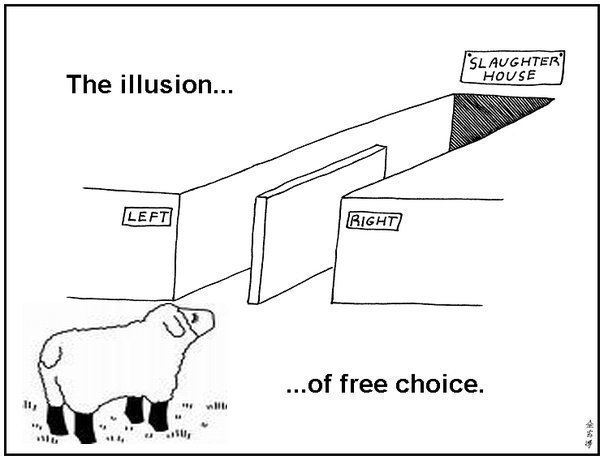
The partisan squabbles between "conservatives" and "liberals," Republicrats and Demoblicans, is part of what G. Edward Griffin has called "The Quigley Formula," named after President Clinton’s mentor when Clinton was a student at Georgetown University. Griffin explains:
In his book, Tragedy and Hope, Professor Quigley explained the value of allowing people to believe that, by choosing between the Democrat and Republican parties, they are determining their own political destiny. To a collectivist like Quigley, this is a necessary illusion to prevent voters from meddling into the important affairs of state. If you have ever wondered why the two American parties appear so different at election time but not so different afterward, listen carefully to Quigley’s approving overview of American politics:
The National parties and their presidential candidates, with the Eastern Establishment assiduously fostering the process behind the scenes, moved closer together and nearly met in the center with almost identical candidates and platforms, although the process was concealed as much as possible, by the revival of obsolescent or meaningless war cries and slogans (often going back to the Civil War). … The argument that the two parties should represent opposed ideals and policies, one, perhaps, of the Right and the other of the Left, is a foolish idea acceptable only to the doctrinaire and academic thinkers. Instead, the two parties should be almost identical, so that the American people can “throw the rascals out” at any election without leading to any profound or extreme shifts
in policy. … Either party in office becomes in time corrupt, tired, unenterprising, and vigorless. Then it should be possible to replace it, every four years if necessary, by the other party, which will be none of these things but will still pursue, with new vigor, approximately the same basic policies.
[Carroll Quigley, Tragedy and Hope: A History of the World in Our Time (New York: Macmillan, 1966), pp. 1247-1248.]
No conservative should actively vote for a Democrat. But many conservatives fear that if they vote for a true conservative Libertarian, a Democrat might be elected as a result.
This unintended result would in fact be very, very good. This is actually an important reason why conservatives should vote for a Libertarian.
If a powerful Republican incumbent were to lose his office because conservatives voted for a Libertarian, it would be well-publicized that the Libertarian caused the defeat of the Republican, not that the Democrat actually won popular support. (Sure, the Democrats would try their best to spin the results, but the election results math is inflexible.)
A Congressman is only elected for a two-year term. Then he faces the voters once again. Conservatives need to think well beyond the next two years. The defeat of a powerful Republican sets in motion political trends which will last for more than two years.
If you and your neighbors vote for a true conservative Libertarian, the election of a Democrat and the defeat of a Republican who is not a true conservative will be the most important and promising political event of this upcoming election.
If you continue to fall for the illusion that the "New World Order" of the Republicans differs from the New World Order of the Democrats, and that voting for one party or the other will significantly change your life, then your children will live in ignorance under the New World Order, a very different world than America's Founding Fathers envisioned.
More and more Americans don't feel represented by either major political party.
A Vote for Kevin Craig is a vote for another Congressman like Ron Paul.
In his legislative fantasies, the amiable Texas congressman would do away with the CIA and the Federal Reserve. He'd reinstate the gold standard. He'd get rid of the Department of Education and leave the business of schooling to local governments, because he believes that's what the Constitution intended.
There have been periods in history when the maverick congressman was not such a rare breed, but this is not one of those periods. Democrats and Republicans have been quite disciplined in recent years -- when party leaders say "jump," the savvy congressman had better inquire how high.
Libby Copeland, "Congressman Paul's Legislative Strategy? He'd Rather Say Not," Washington Post, July 9, 2006; D01
Dr. Paul, however, insists on treating his oath to uphold the Constitution as, well, a solemn promise before God to his constituents. Which is why he is a living rebuke to the hypocritical collectivists who infest the Republican Party, and utterly mystifying to the retread socialists who publish the Post.
William Grigg, "The Only Reason to Vote Republican," Pro Libertate, October 15, 2006
Rioters are not "anarchists";
"anarchy" is usually poly-archy, or multi-archy --
lots of wanna-be archists imposing their desires
by force or threats of violence.
If you want government to intervene domestically, you're a "liberal." If you want government to intervene overseas, you're a "conservative." If you want government to intervene everywhere, you're a "moderate." If you don't want government to intervene anywhere, you're an "extremist."
~ Joseph Sobran
What is wrong with Western civilization is the accepted habit of judging political parties merely by asking whether they seem new and radical enough, not by analyzing whether they are wise or unwise, or whether they are apt to achieve their aims. Not everything that exists today is reasonable; but this does not mean that everything that does not exist is sensible.
The usual terminology of political language is stupid. What is 'left' and what is 'right'? Why should Hitler be 'right' and Stalin, his temporary friend, be 'left'? Who is 'reactionary' and who is 'progressive'? Reaction against an unwise policy is not to be condemned. And progress towards chaos is not to be commended. Nothing should find acceptance just because it is new, radical, and fashionable. 'Orthodoxy' is not an evil if the doctrine on which the 'orthodox' stand is sound. Who is anti-labor, those who want to lower labor to the Russian level, or those who want for labor the capitalistic standard of the United States? Who is 'nationalist,' those who want to bring their nation under the heel of the Nazis, or those who want to preserve its independence?
What would have happened to Western civilization if its peoples had always shown such liking for the "new"? Suppose they had welcomed as "the wave of the future" Attila and his Huns, the creed of Mohammed, or the Tartars? They, too, were totalitarian and had military successes to their credit which made the weak hesitate and ready to capitulate. What mankind needs today is liberation from the rule of nonsensical slogans and a return to sound reasoning.
~ Ludwig von Mises, Interventionism, An Economic Analysis, 1940
"Need" now means wanting someone else's money. "Greed" means wanting to keep your own. "Compassion" is when a politician arranges the transfer.
~ Joseph Sobran
Conservative politicians sometimes fight to keep government from growing, but they never fight to undo the growth caused by the battles they lost in previous years. As a result, government moves in only one direction — to become bigger and bigger and bigger. Libertarians will fight to repeal laws, not just to water down some of the new proposals for new laws.
Conservative leaders have been trying to pump some life back into a conservative movement that has failed to improve the lives of everyday Americans in any tangible, substantial way. But lacking a consistent, straightforward philosophy that applies in every case, conservative writers and politicians have been searching for some kind of noble mission to champion. They have succeeded only in turning conservatism — which once sought to roll back the tyranny of the New Deal — into an embarrassing imitation of liberalism, professing to use the tyranny of government for "good" purposes instead of "bad" ones.
The consistency of libertarianism is one reason it's in the ascendancy today, while conservatism is going the way of liberalism. No matter how conservative politicians say they want to make the economy freer, and no matter how liberal politicians say they want to guarantee personal freedom, whenever any of them pass a new law, it is to make the government bigger.
The Democrats pretend to be the party of those who want a free lunch. The Republicans pretend to represent taxpayers and others who work for a living. But whichever party is in power, government just gets bigger and bigger, the politicians get more and more powerful, and neither the free-lunchers nor the taxpayers get what they wanted.
Do you think there's an important difference between the two old parties? Consider one example: Clinton proposed to take a health-care system made sick by 30 years of government intervention and make it even sicker with a massive makeover. The Republicans fought it, defeated it, gained control of Congress, and proceeded to enact the Clinton health plan piece by piece.
Norman Thomas (1884-1968) was the Socialist Party candidate for President in 1928, 1932, 1936, 1940, 1944, and 1948. Thomas said this in a 1944 speech: "The American people will never knowingly adopt socialism. But, under the name of 'liberalism,' they will adopt every fragment of the socialist program, until one day America will be a socialist nation, without knowing how it happened." In 1962 he said, "The difference between Democrats and Republicans is: Democrats have accepted some ideas of Socialism cheerfully, while Republicans have accepted them reluctantly."
“There are two clear and present dangers to liberty in America. One is known as the Left, and the other is known as the Right. They are dangerous because they seek to use government to mold society into a form they seek, rather than the form that liberty achieves if society is left on its own.”
Why do conservatives seem to have this warm and fuzzy feeling for George W. Bush? I can only speculate it’s because Bush liked to talk a lot about freedom and traditional American values, and did so in such an ungrammatical way that it made him seem sincere.
The outcome of Republican control has been everything Democrats were known for, and libertarians profess to abhor: wasteful government spending, titanic new bureaucracies, federal intrusion in private matters, elective war and a metastasizing national security state.
"During President Bush's first five years in office, the federal government increased by $616 billion," Viguerie writes. "That's a mammoth 33 percent jump in the size of the federal government in just his first five years! To put this in perspective, this increase of $616 billion is more than the entire federal budget in Jimmy Carter's last years in office. And conservatives were complaining about Big Government back then! How can Bush, (Dennis) Hastert, (Bill) Frist and company look us in the eye and tell us they are fiscal conservatives when in five short years they increased the already-bloated government by more than the budget for the entire federal government when Ronald Reagan was assuming office?"
Trading Places: Jeffrey Frankel[alt]
"The pattern is so well established that the generalisation can no longer be denied: the Republicans have become the party of fiscal irresponsibility, trade restriction, big government and bad microeconomics.
"Surprisingly, Democrat presidents have, relatively speaking, become the proponents of fiscal responsibility, free trade, competitive markets and neoclassical microeconomics. This characterisation sounds implausible. Certainly, it would not be recognisable from the two parties' rhetoric. But compare the records of Presidents Carter and Clinton with those of Presidents Reagan, Bush senior and Bush junior."
Jeffrey Frankel is professor of economics at Harvard University's Kennedy School of Government
U.S. will keep oil flowing for now -- The Washington Times Bush Administration gives your tax dollars to Big Oil, and gives the oil to North Korea, freeing up funds for Pyongyang to develop Nuclear Weapons. But at least Al Gore isn't President.
It's obvious that liberalism is intellectually bankrupt today. But, unfortunately, conservatism, as promoted by politicians and pundits, has nothing more to offer than watered-down liberalism — making the government bigger for "good" purposes instead of "bad" purposes.
Conservatives say the government can't end poverty by force, but they believe it can use force to make people moral. Liberals say government can't make people be moral, but they believe it can end poverty. Neither group attempts to explain why government is so clumsy and destructive in one area but a paragon of efficiency and benevolence in the other.
Conservative politicians pat us on the head at election time and tell us how much worse it would be if they hadn't been there to hold back the tide of socialism. But the fact is that they haven't held back the tide of socialism. Government has grown relentlessly. It is time for a better philosophy and a better strategy.
Conservative politicians supposedly believe in economic freedom, but not personal freedom — and yet they vote to put poor people out of work by raising the minimum wage and pass laws to help subsidize their favorite companies with our money. Liberal politicians supposedly believe in personal freedom, but not economic freedom — and yet they vote to censor the Internet and pass laws to take away our right to defend ourselves.
Conservative leaders are happy to declare victory whenever their side wins a minor cut in a department's budget (even if the overall budget continues to get larger), or when a single government function is turned over to a private contractor (even if more money is spent on the function), or when they put through a minor tax cut (even if the overall cost of government continues to grow), or when liberal politicians start talking like conservatives (even though both sides continue to vote for ever- larger government). Libertarians, however, measure victory only in terms of real reductions in government and real expansions of liberty — and conservatives have produced neither of those things. When they hold Pyrrhic victories up to the American people as achievements they are telling us they don't really want to
make a significant difference in our lives; they only want to put a few points on the Scoreboard and then celebrate.
Harry Browne on the Non-Differences Between the Two Major Parties:
A close election might conceivably be decided by one vote in the Electoral College, or in the Congress. But it will not be decided – no presidential election has ever been decided, nationally or even in a single "battleground" state – by a single popular vote.
Therefore, statistically, your individual vote already "doesn’t count." If you died on your way to the polls, it could not possibly affect who gets elected president. Get over it. And if you don’t live in Ohio or Florida or Nevada or one of the other dozen or so "battleground" states, your whole state has already been "assigned" to the red or blue column, your entire state doesn’t count – you could convince a thousand friends to write in Ron Paul or Mahatma Gandhi; no one would even notice.
Yet people keep telling me that unless they vote for Bush or Kerry for Tweedle-Dumb or Tweedle-Brie – their "vote won’t count"? Pretend with me that you’re an old German on your deathbed today. Would you rather tell your grandchildren, "I voted for the Nazis because they seemed better than the Communists and no other party could win"? Wouldn’t you rather be able to rise up and say,
"I publicly denounced the Nazis and the Communists. We were a minority – 1 or 2 percent – but we stood up for the truth and we were right! We proved not all Germans were mindless torchbearers for tyranny! We were ridiculed, we were beaten and jailed, but we saved this nation’s soul. Now children, go and live your lives in a way to make me proud"?
Wouldn’t you?
Because I don’t get it: Let’s say you flip a coin and manage to vote for "the winner," on Nov. 2.
What do you win?
A liberal is someone who can utter a timeworn cliché as though he's the first person in the world ever to say it.
For 45 years the conservatives were suckered by liberals into supporting big government as the way of fighting the Soviet threat. And conservative leaders and politicians became so used to the idea of "saving" the world from threats that, even with the Soviets gone, they're happy to continue tolerating big government — so long as they can continue to play soldier against Saddam Hussein and all the other boogey men of the world.
Is conservatism what you want? Do you want to conserve a $2 trillion federal budget and a $7 trillion debt? Or do you want to liberate yourself from these oppressions?
Liberals and conservatives accuse libertarians of being Utopian dreamers. And yet the liberals and conservatives continually dream up these fantastic government programs that somehow are going to work better than all the failed government programs of the past.
For years it has been known that liberal politicians are more interested in appearance than in substance. For example, they took pride in having imposed sanctions on South Africa — to make a statement of solidarity with the blacks there, even though the sanctions took jobs away from blacks. But conservative politicians are no better. They take pride in being tough drug warriors — because of the moral statement the Drug War makes, even if it increases drug use, escalates crime, and innocent people are killed in drive-by shootings and gang warfare.
To the moralist, other people's lives are of no consequence. All that matters is making the "proper" statement — even if the statement has no permanent or practical value, and even if the action connected to the statement is destructive of the very goal its supporters claim to be working for.
Conservatives sometimes are all for the Constitution when talking about proposed new laws. They fight against new proposals — such as gun-control laws — as being contrary to the Constitution. But they never apply the Constitution to existing laws; they act as though the existing laws were part of the Constitution itself.
Conservative and liberal politicians each like to invoke the Constitution when it suits them, and they each like to ignore the Constitution when it suits them.
No liberal politician says, "I want to see the federal government manage health care, but we must pass a Constitutional amendment first to make it legal."
And no conservative politician says, "I favor the War on Drugs, but only if a Constitutional amendment is passed to authorize the federal government to be involved — as was done with alcohol Prohibition. And I want to attack Iraq, but only after Congress has passed a legal declaration of war."
So you can't believe either conservatives or liberals when they declare their support for the Constitution. And if that's the case, why should you believe anything they say?
Most conservatives have been warning us for years about the dangers of world government. But now that we have world government, they seem quite content with it — so long as a Republican emperor is telling other countries, "Obey my wishes or we'll do to you what we did to Panama, Afghanistan, Grenada, Serbia, and Iraq."
Is there a difference between the Republicans and the Democrats? Of course there is. The Democrats talk about the children while they make government bigger, and the Republicans talk about smaller government while they make government bigger.
On issue after issue — raising the minimum wage, censoring the Internet, bailing out Mexico, and on and on — the Republicans and Democrats argue strenuously and then copy each other. Republican Congressmen accused Clinton of stealing their ideas, even as they plagiarized all the pork-barrel policies of the Democratic Congress.
With no real difference between them, the two old parties taunt each other like children, probe for weaknesses, and try to catch each other in contradictions — looking to put some points on the Scoreboard and win the next election. Meanwhile government gets bigger, more expensive, more intrusive, more destructive, and more dangerous.
The twin parties have become so hopelessly corrupted by power and the perks of governing that our only hope is a third party still too young, healthy, and principled to be infected by their dishonesty and political extortion.
The Democrats say a particular crisis is so severe that they must take another $300 from you. The Republicans say, "No, it's not that bad; we need to take only $200." Or the Republicans say a threat is so great they must take away three more of your civil rights. The Democrats counter by saying, "No, that's too extreme; destroying two civil rights will be enough." Whatever the issue, both sides agree it's a reason for more government, and that you should pay for it. And no matter what price or intrusion they eventually agree upon, within a few years the cost will always be far greater than either side had asked for originally.
No matter which of the two old parties wins an election, the government always becomes bigger, the regulations more onerous. No matter who wins, you will lose — because both sides are for more government, no matter what they say when campaigning. Neither side will stand up for you — for your money, for your freedom, for your family — when the next so-called "crisis" arises.
In 1996 the Republican politicians were upset because they believed President Clinton was stealing their issues from them. And he was. But turnabout is fair play: for 60 years the Republicans have been legislating like Democrats.
Because neither the Republicans nor Democrats stand for any fixed principles, they can't engage in a real debate. Instead, they play games — trying to score points off each other by catching each other in inconsistencies. Or they argue about the meaning of statistics — all the while knowing that neither side has a policy that differs substantially from the other, so the statistics are politically meaningless. They are quibbling while America burns.
Neither the Democratic president nor the Republican Congress has done anything to get government out of our lives. And since neither party offers to improve our lives significantly, we really have no self-interest in favoring one over the other. So we choose up sides based on such things as character and morals — even though Ronald Reagan, a man of apparent good character, did no more to reduce government than Bill Clinton, an obvious rogue.
The Democrats believe the government can end poverty, even though for 30 years the government's policies have expanded poverty in America The Republicans believe the government can end drug use, even though for 30 years the government's policies have escalated drug use and crime in America.
Yes, there's a difference between the two major parties. There's always a difference. But it's a tiny difference. And if you vote on the basis of that small difference, the difference will never become larger — and you'll never get a more attractive option than what you have now — and the country will continue its movement in the same direction — toward bigger and bigger government.
A Republican in the presidency isn't the "lesser of two evils." He will do practically the same things a Democrat would do. But with a Democrat in office, conservative writers and politicians will denounce his big-government schemes. They won't do that with a Republican in office. As a result, a Republican isn't the lesser of two evils; he represents the worst of two evils: big government and no opposition.
Bush, Obama, or Romney?
Chuck Baldwin chose the links below. They show that conservatives must not trust President XXX. Is XXX Bush, Obama, or Romney? Does it matter?
 . Available from