Congressional Issues 2014 TAXATION VS. PRIVATE PROPERTY Fundamental
Tax Reform
Taxation is Theft
The American Revolution (1776) was fought over tax rates of 2-4%. Americans today pay ten
times more than the amount our Founding Fathers took up arms to fight. Acceptance of this state of affairs is un-American.
Thomas Paine, in his influential book Common Sense, noted that Samuel warned Israel (1 Samuel
8) that the king they desired would take one-tenth of their income. This was intended as a terrifying threat of monstrous tyranny.
Today it would be called "tax-relief."*
God commanded, "Thou shalt not steal." Today's politicians add, " . . .
except by majority vote." Acceptance of this state of affairs is not only un-American, it is immoral.
America's Founding Fathers would say today's Americans are guilty of idolatry for accepting monstrously unBiblical and tyrannical
tax rates without protest.
Real tax reform begins with the recognition that taxation is extortion, the seizing of income or property under threats of force
or violence.
It is important to remember that government interference always means either violent action or the threat of such action.
The funds that a government spends for whatever purposes are levied by taxation. And taxes are paid because the taxpayers are afraid of offering resistance
to the tax gatherers. They know that any disobedience or resistance is hopeless. As long as this is the state of affairs, the government is able to collect
the money that it wants to spend. Government is in the last resort the employment of armed men, of policemen,
gendarmes, soldiers, prison guards, and hangmen. The essential feature of government is the enforcement of its decrees by beating, killing, and imprisoning.
Those who are asking for more government interference are asking ultimately for more compulsion and less freedom. [I]n
face of the modern tendencies toward a deification of government and state, it is good to remind ourselves that the old Romans were more realistic in
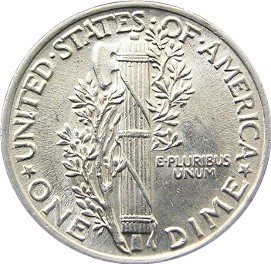
symbolizing the state by a bundle of rods with an ax in the middle than are our contemporaries in ascribing to the state all the attributes of God.
"Fasces" from the shield of the Partito Nazionale Fascista
"New Deal" fasces, "Mercury" Dime, (1916–1945)
Congress should abolish all taxes. As step-by-step measures, Congress should:
make permanent and accelerate the phase-in of tax cuts enacted in 2001, including rate reductions, estate tax repeal, and pension liberalization;
repeal the individual and corporate alternative minimum taxes;
reduce the taxation of capital by lowering personal taxes on capital gains and dividends, which are currently taxed at both the
corporate and individual levels;
expand Roth individual retirement accounts by greatly increasing contribution and income limits and repealing withdrawal restrictions
to create a large all-purpose savings account available to every American;
index individual income tax brackets to nominal income growth rather than inflation to prevent hidden tax increases caused by ‘‘real
bracket creep’’;
make permanent the 30 percent expensing provision for capital investment enacted in 2002, and expand it to ultimately allow 100 percent
expensing;
ensure that all tax cuts are consistent with replacing the income tax with a low-rate consumption-based tax, such as a Hall-Rabushka
flat tax, a savings-exempt income tax, or a national retail sales tax; and generally
make all federal taxes lower, flatter, and simpler.
enact a five-year tax cut of at least $2 trillion; the tax cut bill should
repeal the Bush and Clinton tax increases of 1990 and 1993, thus returning to two income tax rates, 15 and 28 per-cent;
abolish the capital gains and estate taxes;
create a $25,000 per household tax-free universal savings account; and
index the income tax brackets for real income growth so that tax liabilities do not rise faster than Americans’ incomes;
not allow states to unfairly tax the Internet;
end the withholding tax;
send an annual tax disclosure form to all taxpayers;
require a two-thirds supermajority vote to raise taxes;
enact an alternative maximum tax for individuals and businesses; the MAXTAX should be set at 25 percent of gross income and replace the filer’s income and payroll taxes;
replace the income tax with a national sales tax and close down the Internal Revenue Service; and
refund taxes to Americans if tax revenue grows faster than personal income.
adopt a "fair tax" system as a transition to the abolition of all taxes.
If Congress will not adopt a requirement for a roll-call vote of at least two-thirds of the whole number of each house of Congress to increase revenue in any way, the
Constitution should be amended to require such.
(a) total federal outlays for any fiscal year shall not exceed total receipts for that fiscal year without at least a three-fifths vote of the whole number of each House of
Congress; (b) the limit on United States debt held by the public shall not be increased without at least a three-fifths vote of the whole number of each House; and (c) no bill
to increase revenue shall become law unless approved by at least a majority of the whole number of each House by a roll-call vote. If Congress will not impose these
requirements, the Constitution should be Amended to do so.
[CATO policy recommendations from 2008. Have we made progress through moderation?]
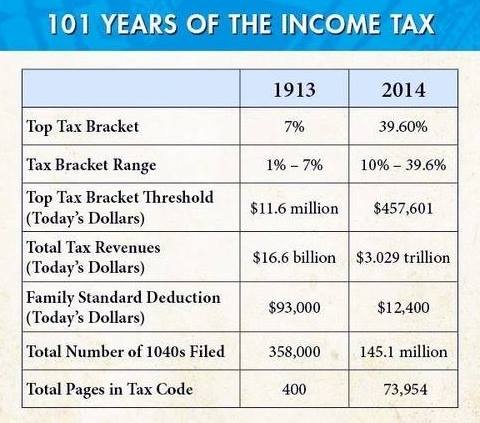
The original federal income tax originally imposed a tax of only 1 percent on incomes of $56,000 or more, with a maximum of just 7 percent for incomes over $7
million (both dollar figures adjusted for inflation to 2001). Strange how new taxes, once in place, begin to bleed more and more people with higher and higher rates that
kick in at lower and lower levels. -- Harry Browne
The IRS must be abolished. Read three horror stories about IRS
abuse. These examples are so systematic that Congress has held hearings on the matter. The IRS is worse
than anything America's Founding Fathers experienced prior to 1776.
"It would be an instructive exercise for the skeptical reader to try to frame a definition of taxation which does not also include theft. Like the robber, the State
demands money at the equivalent of gunpoint; if the taxpayer refuses to pay his assets are seized by force, and if he should resist such depredation, he will be arrested or
shot if he should continue to resist."
Is
this anti-taxation position disrespectful of "the rule of law?" Yes, argues one writer. America's
Founding Fathers would say, "To hell with 'the rule of law.'" Is this "revolutionary?" It's hard to imagine
anything more revolutionary than today's atheistic, socialistic government and its "Rule of Law." The confiscatory state is destroying family,
religion and morality. This website favors and defends family, religion, and morality, and this motivates and informs our attack on taxation.
Let us reflect upon the fact that one of the apostles of Christ was a Hebrew named Matthew (Matthew 9:9-13; Mark 2:14;
Luke 5:27-28). He is the only apostle whose individual call is recorded in the Synoptic Gospels. By occupation, he was a publican (tax collector) who
worked on behalf of the Roman government. Barclay has noted that “there was no class of men in the ancient world more hated than tax gatherers” (1959, p.
59). Ancient writers—both pagan and Jewish—put tax collectors in the same category with harlots, robbers and a variety of other scoundrels (Green, et al.,
p. 805). Even the New Testament associates publicans with the most disreputable people (cf. Matthew 21:31-32; Mark 2:15; Luke 15:1). The Jews distrusted the
publicans so intensely that they “declared them incapable of bearing testimony in a Jewish court of law” (Edersheim, p. 57).
These facts being the case, who can imagine that forgers, contriving to put together the New Testament documents in order to provide a rationale for the success
of Christianity, would have invented the character of a “publican” as one of Jesus’ apostles? To compound the
matter, this “tax collector” is the writer who is reputed to have composed the gospel record that was specifically designed to present the case of Jesus, as
the fulfillment of Old Testament messianic prophecy, to the Hebrew people! The selection of Matthew, as one of the apostles, has the “ring” of absolute
truth. Apologetics Press - A Subtle Argument for Inspiration
The Tax Path Away from Liberty Not one of these taxes existed 100 years ago, and our nation was the most
prosperous in the world and had the largest middle class in the world... - George Amberg, January 15, 2005 [LewRockwell.com]
The National Sales Tax Disaster Bush and the Republicans probably do not want to cut government at all, so
we shouldn’t fall for their Republican trick of "tax reform." Spending increasers make bad tax cutters. - Anthony Gregory, December 9, 2004 [LewRockwell.com]
Subway Tax in the Rancid Apple Last year the New York City Subway system carried 1.41 billion passengers. In
1947, the historic high point of ridership, the system carried 2.02 billion. That means the latest numbers constitute an incredible falloff of some 30% in a city whose
population has stayed about the same over the past 60 years. - Gregory Bresiger, February 28, 2003 [Mises]
What's Wrong with Taxation? In fact, taxation is a most uncivilized way of obtaining funds, given that it
boils down to nothing less than extortion. - Tibor R. Machan, December 4, 2002 [Mises]
Taxes and the General Welfare We are approaching April 15, when people's
checkbooks remind them that even if "taxes are the price we pay for a civilized society," it doesn't follow that the civilization we get is worth the taxes we are
forced to pay. - Gary Galles, April 11, 2002 [Mises]
The Envy Tax "Although death taxes are a rather insignificant source of revenue for
the federal government, they are very popular with economic and social reformers." - Hans F. Sennholz, August 2, 2001 [Mises]
I Got My Check "Like so many other Americans, I have received my 'tax relief' pittance from the
national government. Unlike many Americans, I don’t like it. I’m not bought. I’m mad as hell." - Brad Edmonds, July 26, 2001 [LewRockwell.com]
And He’s Taxing the Stairway to Heaven... "The combination of a booming economy and
confiscatory tax rates have combined to saddle governments everywhere with the kind of problem politicians love – finding ever more black holes into which they can shovel the
embarrassing surpluses that otherwise keep piling up in excess of inflation and population growth, combined." - Vin Suprynowicz, July 18, 2001 [LewRockwell.com]
The Mommy Tax "Is motherhood a boon or a burden for women today?" - Cathy Young, June 2001 [REASON]
Feminists for Taxes "Patricia Ireland and her National Organization for
Women have released a statement attacking the Bush budget and tax-cut plan. She points to deficiencies in tax revenue and spending by virtue of accusing Bush of 'pushing budget
and tax cuts that will hurt women's physical and economic health as well as the safety of women and families.'" - Karen De Coster, May 31, 2001 [Mises]
We All Pay For High Taxes "...high taxes may take a lot of money from the wealthy, but those high
taxes are used to increase the power of big government over all of us, rich and poor alike." - Ryan McMaken, March 14, 2001 [LewRockwell.com]
The Thing About Taxes "There is nothing compassionate about taxes. They are the price we pay
for permitting the government to dismantle the civilization created by the market economy." - Llewellyn H. Rockwell, Jr., March 9, 2001 [LewRockwell.com]
Anti-Tax-Cut Nuttery "I'm continually amazed by the half-baked arguments made against George W. Bush's $1.5
trillion tax-cut plan. Has the Left learned absolutely nothing over the past couple of decades about how taxes impact the economy?" - Stephen Moore, March 8, 2001
[CATO]
Taxing the living and the dead "Those who never earned their own money want the
government to tax the life's savings left by people who did earn their own money, even though these earners already paid taxes on their incomes when they were alive." -
Thomas Sowell, February 22, 2001 [TownHall.com]
New study: Holiday 'Grinch' taxes gobble up 41% of your travel costs "Feeling strapped
for cash as you prepare to take off for Christmas vacation? Maybe that's because hidden travel taxes have added an astounding 41% to the cost of your trip..." -
released December 20, 2000 [LP Press Release]
Tax man someday may ride with you "One day, perhaps, every car on the road will be equipped with a
computer that uses satellite technology to record every mile you drive, and in which states and on which roads. Then the government will use that information to tax you for
your driving." - Larry Sandler, December 6, 2000 [South Coast Today]
Death, Wealth, and Taxes "The death tax is a part of a crusade against people who manage to accumulate wealth
-- it's class warfare." - Walter Williams, October 26, 2000 [Capitalism Magazine]
Europe's High Fuel Taxes: Virtue or Vice? "Last week an acquaintance in England sent me this shocking note:
'Part of the tax is pegged to price, so an increase in fuel prices raises the tax. Prices are now some 90 pence per liter, over $6.00 per gallon, with $5.00 of that tax. The
average Brit pays over $100 a week to run his car, and some $80 of it goes to the government.'" - Andrew West, CFA, September 20, 2000 [Capitalism Magazine]
Death Tax Repeal a Hoax "Every once in a while, it appears that Congress does something good for the
American people. Such a moment came on Friday when the House passed the 'Death Tax Elimination Act of 2000.' Sounds wonderful, especially these days when future estates are
accumulating rapidly due to economic expansion. Have the Republicans overcome their spineless nature to finally stand up for principle?" - Llewellyn H. Rockwell, Jr.,
June 12, 2000 [LewRockwell.com]
The Hidden Cost of Taxation Politicians can nudge certain taxes up without hearing from taxpayers, except for some
brief grumbling. - Dwight R. Lee, March 2000 [FEE]
Hide the ham: Health fanatics want to slap a "fat tax" on your favorite foods "That
scrumptious meal you had for Thanksgiving -- and the festive feast you're probably planning for Christmas -- may get hit with a 'fat tax' if certain public health fanatics get
their way, the Libertarian Party warned today." - released December 8, 1999 [LP Press Release]
Grave Robbers: The Moral Case against the Death Tax "The death tax rewards a 'die-broke' ethic, whereby the
wealthy spend down their wealth on lavish consumption, and discourages economically and socially beneficial intergenerational saving." - Edward J. McCaffery, October 4,
1999 [CATO] (PDF format)
Congress's Tax Cut Imperative "For four years congressional Republicans have talked ad nauseam about the
middle-class squeeze. Yet -- because of bracket creep -- the squeeze has become a bear hug after four years of a GOP Congress." - Stephen Moore, June 17, 1998 [CATO]
Equality and the Death Tax "So long as parents care for their children, the primary means of
transferring money through the generations will be through inheritance. It benefits bequestor and heir, strengthens family ties, and increases long-term savings. When the state
intervenes in this process it increases its coffers at the expense of the smooth operation of family, society, and economy." - Alexander Tabarrok, September 1997 [Mises]
Working Overtime Is More Taxing Than You Think "It turns out that even if the worker receives time and a half
for overtime, a surprisingly large share of the bonus wages goes straight to the tax collector." - George Nastas III and Stephen Moore, March 6, 1997 [CATO]
Taxes and Distortion The government always wants more of our money, and too many economists are ready
to make the case for surrendering our last dime. - Llewellyn H. Rockwell, Jr., March 1996 [Mises]
The ABCs of Capital Gains Tax This study examines the historical experience with the capital gains tax in the United
States, as well as the findings of more than 50 economic studies on capital gains taxation." - Stephen Moore and John Silvia, October 4, 1995 [CATO]
Marriage Tax Penalty Calculator "Follow these instructions to
find out how much the Marriage Penalty costs you in taxes that you simply would not owe if you and your spouse were not married." [Concerned Women for America]
The Budget and Economic Outlook: Fiscal Years 2001-2010 [CBO] - One snippet on Individual Income
Taxes, "Individual income taxes account for most of the recent rise in revenues as a percentage of GDP. From 1993 to 1998, those receipts averaged growth of more than
10 percent a year...Nonetheless, they grew faster than GDP, reaching their highest share of GDP in the postwar period in 1999. Their share is expected to peak in 2000 and then
to slowly recede as some of the factors that caused its rise moderate. But by 2005, the factors tending to boost the share of individual tax receipts begin to dominate and
cause the ratio to rise through 2010."
"Voluntary Taxes?"
This week the Seattle City Council approved an ordinance that, as
of January, will require shoppers at grocery, drug, and convenience stores to pay 20 cents for each paper or plastic bag they use:
The city will distribute at least one free reusable bag per household, and it will consider providing more free bags to
low-income shoppers.
"This is a voluntary fee," said Council President Richard Conlin, who worked with Mayor Greg Nickels on the proposal.
"No one has to pay it. You only have to pay it if you choose not to use reusable bags."
Can we stop it with this "voluntary tax" nonsense already? If you put your groceries in an unapproved bag, the government forces you to pay the
fee, so it's not voluntary. By Conlin's logic, sales tax also is voluntary (you don't have to buy stuff), as are alcohol and tobacco taxes
(you don't have to drink or smoke), air travel taxes (you don't have to fly), gas taxes (you don't have to drive), property taxes (you don't have to
own a house), and income taxes (you don't have to make money).
Make the Holiday Permanent "A tax holiday is better than a rebate because it eliminates the absurd
costs associated with sending money to DC only to have it sent back again in the new form." - Llewellyn H. Rockwell, Jr., December 5, 2001 [LewRockwell.com]
In Praise of (Some) Corporate Lobbyists "Congress is looking for a simple and effective way to get cash into
the hands of those who can use it to get the economy moving again. AMT repeal would do exactly that since the AMT is a particularly heavy burden on large industrial companies
that do much of the capital investment in this country." - Chris Edwards, November 5, 2001 [CATO]
Tennessee in Revolt "With the General Assembly
poised to put another state income tax on the books, hundreds of angry taxpayers revolted, descending on the state capitol in Nashville with shouts of 'No new taxes!'" -
Gregory Bresiger, July 18, 2001 [Mises]
Killing the death tax "Unfortunately, the best argument for the complete repeal of the
estate tax rarely is raised. It is that people who earn money have demonstrated by their ability to earn the money that they're far more competent to disburse it than
politicians are." - Harry Browne, February 21, 2001 [WorldNetDaily]
A Wage Earner Against the Estate Tax "...in a capitalist
society, free of governmentally imposed class distinctions, talented newcomers—self-made men—again and again rise from the ranks of the relatively poor and finish their
lives as the richest members of society. Rockefeller, Carnegie, Ford, and in our day, men like Gates and Buffet, did not enter the world in possession of any vast fortune. They
themselves created their fortunes. Heirs can retain their fortunes if they do not waste them, but only if they possess considerable talent can they maintain their fortunes in
the first rank of wealth." - George Reisman, February 14, 2001 [Mises]
Tax Cuts: Now More Than Ever "The good news is that America generally has lower tax rates than many of our
competitors. This has enabled us to become more prosperous in the past two decades. But the bad news is that other nations are beginning to catch up. Germany and Japan have
reduced tax rates, and other countries are looking to follow that example. This means that we will have to lower our tax rates if we want to remain the No. 1 economy in the
world." - Daniel J. Mitchell, December 19, 2000 [Capitalism Magazine]
Kentucky town would rather hold bake sale than raise taxes on residents "'We've paid for a
new $26,000 police car, a $145,000 fire truck, a $58,000 garbage truck and a $30,000 dump truck,' said Mayor Betty Howard. 'We couldn't have done it without the shop.'" -
December 8, 2000 [The Dallas Morning News]
The Case For Tariffs-Only "For over two centuries, one of the most useful litmus tests of economic
rationalism has been the tariff test." - Gary North, October 14, 2000 [LewRockwell.com]
Tennessee Should Be Cutting Taxes, Not Raising Them "If the governor will not discipline spending in
Nashville, the solution for Tennessee is not to get a new income tax, but rather to get a new governor." - Stephen Moore, November 17, 1999 [CATO]
Capital Markets: The Importance of Lower Taxes "The more money that remains in the hands of the
private sector, the more will be available to investors to support innovation." - Steve Slivinski and Solveig Singleton, September 13, 1999 [CATO]
Time to Replace the Income Tax "Ultimately, what is most hopeful about the tax replacement scheme is not the
increased economic efficiency and productivity that would undoubtedly result. Rather, it is the psychological impact it would have on the American people, who would suddenly
find themselves living in a nation where it was none of the government's business how much money they made or how they made or spent it." - Edward H. Crane, October 4,
1996 [CATO]
The Joy of Tax Cuts "The point of all tax reform should be to keep more private property private. No
matter how it is collected, a tax is a tax, and therefore economically destructive. Taxes should be cut anywhere and everywhere, and never be 'replaced.'" - Lew
Rockwell, Jr., June 1995 [LewRockwell.com]
A tax on aggression — like a pollution tax, or other Pigovian taxes on negative externalities — is not itself aggression.
If my neighbor is aggressing against me by polluting my land, and the government levies a tax on my polluting neighbor, then my
neighbor is (still) aggressing against me, and the government is aggressing against my polluting neighbor.
There were people who saw the smokestacks of the industrial revolution not as pollution, but as progress. Monopolistic Aggression is not the way to resolve this
conflict of visions.
A tax on the economic rent of land is aggression only if you disagree with the geolibertarian premise that because land is not created
by labor, the occupation of land does not include an entitlement to its economic rent. (The economic rent of a piece of land is equal to the economic advantage obtained by using
the site in its most productive use, relative to the advantage obtained by using marginal land for the same purpose, given the same inputs of labor and capital.) Land rent is
just one of many questions about property rights that cannot be settled by invoking the non-aggression axiom. Other questions relate to atmosphere, bodies and streams of water,
rain, sunlight, wind, migratory game, fisheries, minerals, spectrum, orbits, expressions, inventions, and reputations. Depending on your axioms about the nature of property, any
or all of these could in principle be taxed without committing aggression.
According to Wikipedia,
"Geolibertarians" are advocates of geoism, which is the position that all land is a common asset to
which all individuals have an equal right to access, and therefore if individuals claim the land as their property they must pay rent
to the community for doing so."
"Rent" here is a euphemism for "taxes." "Community" is a euphemism for "Monopolistic Aggression" or "The State."
I'm not sure what it means to say that everyone has "equal right" to access my property. I'm not sure why Disney cannot charge admission to the "Haunted
Mansion" without having to pay taxes to all the people who were denied the right to free and equal access to Disneyland.
This last sentence is inaccurate. Taxation cannot occur without aggression. Holtz means that the aggression would be "justified."
Thus one could assert "land rent is theft" and say that morality requires an exaction (i.e. tax) against land rent. One could
similarly assert "pollution is theft" in defense of taxing negative externalities. An anti-aggressionist could even assert "free-riding is theft" in defense
of a tax levied only to fund a "public good" (i.e. a non-rivalrous non-excludable product or service) for minimizing aggression — such as national defense or
guaranteed access to the justice system. As geolibertarian economist Fred Foldvary says: "government works and services increase land value, and so long as these are
provided and funded by government, a levy based on the site value returns to government that land value and rent added by the services." A geolibertarian could argue that a
tax on land rent is not strictly coercive, but rather a form of restitution.
"Restitution" is something given back to victims of aggression. If I rent out my spare bedroom, I am not aggressing. I
am not "aggressing" if the government claims to have "prevented another 9/11" though its "defense" department.
Taxes used to finance the protection of liberty are fundamentally different from taxes used to finance rent-seeking (i.e. extracting
undeserved benefits from the government). If taxation to finance justice for all is so horrible, so akin to "theft" and "slavery", then any form of
taxation should be able to serve as the poster child for the anarcholibertarian argument against coercive minarchism. If instead anarcholibertarians have to paint an image of
John Q. Taxpayer being forced at gunpoint to redistribute his income to others, then they just aren't engaging my position. The image I defend is of John Q. being forced at
gunpoint to pay his pollution taxes (corresponding roughly to his pollution aggression) and his land value taxes (corresponding roughly to the services available for him to
free-ride on). Can anarcholibertarians argue against that, or not?
Suppose I like flowers. I plant some in my garden. Suppose my neighbor likes honey. He builds a bee-hive. My neighbor's bees
pollinate my flowers. I receive a benefit. I don't pay my neighbor for this service. Have I "aggressed" against my neighbor? On the other hand, my neighbor benefits
from my flowers, which help his bees make honey. Has my neighbor unfairly "benefited" from my flowers. Is my neighbor a "free-rider?" Should the government
tax us both for being "free-riders?" What if the government establishes a "Department of Happy Thoughts," which employs an army of bureaucrats to think
"Happy Thoughts" about my flowers and my neighbor's honey, thus "manifesting" an increase in our nation's "Gross National Product" through the
"Law of Attraction." Am I aggressing against "the community" by failing to
pay for this valuable government service?
Saying taxation is a form of confiscation is like saying assault is a form of murder, in that only 100% taxation qualifies as actually
confiscating the object of the tax. Just because taxation and confiscation both involve threatened force doesn't make them the same thing.
Suppose I want to buy a Ford Taurus. I have $12,650. I go to the Ford dealer, only to find out that the price of a Taurus is $23,000.
The amount above $12,650 represents taxes imposed by government on various levels of production, according to Americans
for Tax Reform. I will not be able to buy the car. Please explain to me why 100% of my Taurus was not confiscated from me. Please tell me why $10,350 was not
"confiscated" from me if I paid the full sticker price for the car.
Seize/confiscate has connotations that are not satisfied by taxation. One is that the seized/confiscated thing is a distinct entity or
collection that was the particular target of an intent to take possession of it. A mafia goon might "seize" or "confiscate" your wallet or all the cash you
happen to have in your pockets, but if instead he says he'll be back each week for $100 in protection money, a native speaker of English would instead say he is
"exacting" or "extorting" when he collects it, not "seizing" or "confiscating". The object of a seizure or confiscation is a particular
thing that you in some way possess at the time of the threat or exercise of the force involved in the seizure or confiscation. By contrast, taxation/exaction/extortion often
imposes a debt that is satisfiable not by any particular thing(s) you currently possess, but rather by some dollar-denominated (but otherwise arbitrary) subset of your future
earnings or holdings. The goon doesn't care which hundred-dollar bill you give him next week, or that you don't have any now, so long as you cough one up each week. Thus
taxation is in form more like extortion than it is like theft.
Is there really a moral distinction between "extortion" and "confiscation," such that taxation (which is
really "merely" extortion) is not immoral?
Extortion is not theft???
Most Libertarians seem to recognize that coercive taxation — or something that could be denounced as such — will be necessary indefinitely. Of
the the nine LP presidential tickets, at least seven were headed by men who conceded (then or later) that coercive taxation will be necessary indefinitely — rejecting the
pre-Portland Platform's call for abolition of all taxation and immediate non-enforcement of tax laws. Andre Marrou may merely have opposed "excessive
taxation", which would make it 8 out of 9. And while David Bergland was a Rothbardian radical when nominated in 1984, by 2000 he was managing the campaign of Harry
Browne, who wrote at the time that "until we find a way to finance government without taxes or a way to assure our
safety without any government, some form of taxation will be necessary". So it might actually be 9 out of 9.
It is true -- but ambiguous -- to say that taxes will be "necessary" as long as we have government. Government by
definition is funded only by taxation, not by donations, user fees, or bake sales. "The Government" doesn't exist without
"taxation." The question is, Does a prosperous and harmonious human society require "the government," (the only institution funded by "taxation")?
Taxation and Human Action
Considered vertically, there are two basic categories of human action: obedience and disobedience. Considered
horizontally, there are two basic categories of human action: service and aggression.
The servant is the producer, who either freely gives away the goods and services he produces, or relies solely on persuasion
to complete an exchange of money or other goods and services for his own productivity.
The aggressor is the parasite, who relies on conquest, extortion, and threats of violence to compel others
to give him what he wants, but has not produced or has nothing for which he can trade for what he wants. Parasites can be passive, waiting for others to steal on their
behalf from the productive, or elitist, believing that they have some superior right to confiscate from others, based on the alleged wisdom or "common good" of
their confiscation and alternate use of the goods and services.
Franz Oppenheimer distinguished the "servant" and the "aggressor" as "Economic Man" and "Political Man" respectively.
A hot dog vendor was kicked from the curb outside New York City's Metropolitan Museum of Art last week for failure
to pay his monthly rent—of $53,558. Pasang Sherpa was under
contract to pay the Parks Department $362,201 a year for a stand on the south side of the Met's entrance and $280,500 for another on the north side. That's a lot of hot
dogs.
At $2 a dog, it's an average of 880.4 hotdogs per day, or 110.05 hotdogs per hour (8 hours of vending per day) for the two carts. After you sell that many wieners and pay the
city your rent, you can start making some real money.
* This passage of Scripture was also debated in the New York ratifying convention, Friday, June 20, 1788. (Jonathan
Elliot, Debates on the Adoption of the Federal Constitution, Vol. 2, p. 216.)