Congress should:
- embrace the principles of classical liberalism
- reject the principles of modern "liberalism"
The theme of this campaign is "Liberty Under God."
"Liberals" used to support liberty, though some did not support God.
Today, "liberals" hate both liberty and God.
What it used to mean, what it means today.
What Should Liberals Liberalize?
by
Daniel B. Klein
Do "liberals" generally favor liberalization? Do they favor greater freedom to choose?
Liberalization is the loosening of restrictions on individual liberty.
Or do "liberals" generally oppose liberalization?
The Democrats have done well at all levels nationwide. Are the Democrats liberals? Do they favor liberalization?
If the Democrats are liberals and care about the poor, here are some things they should move to liberalize —
School choice. Giving parents the purchasing power to choose
schools for their children improves education. Sweden has vouchers and it works well. Evidence increasingly shows that choice works and top-down
government control doesn't.
Immigration. Let more in, including the low-skilled. Most Mexicans who come are much poorer than
poor Americans, and they send part of their earnings to family members abroad. Their experience in the United States imparts liberal norms and they
spread those norms abroad. Why should concern for the poor end at the border?
International trade. When two people engage in voluntary exchange, they both expect to gain, even
when they live in different countries. When Americans trade with Brazilians or Indians, there are mutual gains. The trading partner abroad is often
poorer than the American. As Paul Krugman and many before him have explained, free trade allows firms anywhere in the world to take advantage of
scale economies, producing more for humanity while consuming fewer resources. Everyone wins. Economists overwhelmingly support freer trade.
Agricultural subsidies and protectionism. Prices of certain agricultural products are propped up by
an array of governmental restrictions and cartel measures. Everyone pays the price at the grocery store, and the impact is regressive. Most
economists support liberalization and the reduction of farm subsidies.
Drug prohibition. Most of the hundreds of thousands caged in prison cells on drug violations are
poor. The illegal drug trade especially ravages poor neighborhoods. Those who suffer from impure, ill-labeled black-market drugs are poor. Most of
those injured in black-market violence are poor. Most economists who publish judgments on the issue favor liberalization.
Occupational licensing. Licensing requirements restrict the supply and variety of services and raise
prices. They also prevent poorer people from entering trades. Economists who write on the subject say that voluntary certifications, reputation, and
other assurances work well, and they favor liberalization. Morris Kleiner of the University of Minnesota and Alan Krueger of Princeton University
find that occupational licensing affects upwards of 25 percent of the workforce. Both have published judgments favoring liberalization.
The minimum wage. Unskilled workers have to compete against higher-skilled workers, machines, and
anything else employers might do with their money. The minimum wage law strips unskilled workers of their primary means of competing: Lowering their
price. Even when the minimum wage does not put them out of work, it affects the non-wage job attributes. It stands to reason that unskilled workers
who get jobs at the minimum wage tend to face higher work demands, less flexibility, less on-the-job training, less non-wage benefits, and less
recognition and consideration. In a depressed economy it is important that labor markets remain fluid and flexible.
The Food and Drug Administration control of pharmaceuticals. All drugs and devices are banned until
individually permitted by the FDA. The costs, delays, and uncertainties suppress the development of drugs that would have saved lives. Economists
who publish judgments on the matter resoundingly support liberalization.
Urban transit. State and local laws prevent market forms of transit — shuttles, jitneys,
mini-buses, share-ride taxis, and smart carpools. Free-market forces have been largely forsaken to protect and serve governmentally run or planned
systems that ill-serve the goals of mobility and efficiency. Economists who write on rail transit largely agree that most rail transit projects are
ill conceived.
Rent control. Roughly 200 localities still have rent control. Economists who publish on the matter
largely agree that it reduces the supply and the quality of rental-housing and generates conflicts. It increases prices of housing outside the
rent-controlled sector. Very likely in the long-run it increases rents even in the controlled sector.
Do we think the Democrats will move to liberalize any of these?
What will they liberalize?
Why again do we call them "liberals"?
Daniel Klein is an Adjunct Scholar for the Cato Institute,
professor of economics at George Mason University, and editor of Econ Journal Watch.
More by Daniel B. Klein |
|
|
From the Libertarian Party of California: www.ca.lp.org
Where Have All the
Liberals Gone?
by L. K. Samuels
Mon, 1 Oct 2007
Liberalism has been the major ideological underpinning of the American republic, and the driving force of modernity. Coming out of the Enlightenment and John Locke's
writings, liberalism promoted individual rights, human rationality, limited government, private property, laissez-faire markets and free trade. The core values of liberalism
have always been tolerance, free choice, and open-mindedness. Yet today, liberalism seems to have all but abandoned most of these long-honored virtues.
Many
"liberals," ranging from MIT linguistics professor Noam Chomsky to former White House chief of staff Leon Panetta, have endorsed the reinstatement of compulsory
military service. Charles Rangel, the liberal congressman from New York, recently introduced a bill to "require all persons in the United States between ages 18 and 42
to perform national service, either as a member of the uniformed services or in civilian service in furtherance of the national defense and homeland security." Even
Democratic presidential hopeful John Edwards joined the involuntary servitude choir: "One of the things we ought to be thinking about is some level of mandatory service
to our country."
What of liberal Hillary Clinton's solutions on improving health care? Her first attempt to monopolize health care under the federal government
occurred in 1993. The plan imposed stiff penalties and possible jail time for patients who switched doctors without approval. Anyone refusing to join government-mandated
health system would be fined $5,000, and doctors could spend 15 years in jail if they received "anything of value" in exchange for getting their patient quicker
medical service. The program also required a national identification card embedded with data about a patient's medical history. Clinton's current proposal also has penalties
for those who would refuse to acquire insurance under her universal health care program.
Take Social Security. Established in 1935 by the maestro of modern liberalism,
Franklin D. Roosevelt, this program is compulsory, without any general provision to opt out or quit. Nobody is exempt except congressmen and senators who authorized their own
very generous retirement programs. The sacred cow of liberalism, Social Security offers jail time to anyone who refuses to participate. Interestingly, this retirement concept
did not originate with FDR's administration. New Deal staffers looked to Europe for inspiration, and decided to copy the social retirement program that operated in Hitler's
Germany.
What about the Iraq War and civil liberties? Almost every liberal member of Congress voted to invade a nation that had never threatened or attacked America.
The same outcome occurred when Congress overwhelmingly passed the USA PATRIOT Act. In 2006, when the USA PATRIOT Act came up for another vote, only nine Democratic senators
voted against its reauthorization. Even the gutting of habeas corpus and extending unwarranted wiretapping abuses were assisted by many elected liberal Democrats.
When
Berkeley peace activist Cindy Sheehan visited Venezuela, she hugged and lavishly praised President Hugo Chavez for his commitment to "life and peace." But this
former military officer sits at the precipice of dictatorship. He acquired the power to "rule by decree," which allows him to make laws without any congressional
oversight or discussion. Chavez packed the Venezuelan Supreme Court, confiscated private property, shut down the only major opposition TV station, and is attempting to alter
the constitution to allow him to become president for life. His slogans painted on sides of buildings read "Socialism or Death," provoking mischief-makers to
substitute "is" for "or."
Sometimes called "laissez-faire liberalism," the original version sought to liberate mankind from the
domination of government and religious authorities and allow citizens to run their own lives as they saw fit. But contemporary liberalism changed. Some observers, including
Leonard Liggio, research professor of law at George Mason University, believe that "collectivism" captured modern liberalism, morphing it into something that
resembles European socialism. If anything, modern liberalism has come to embrace security and control over freedom and spontaneous order. Today's liberals no longer question
authority; they have become part of it, degenerating into advocates of parochialism, intolerance and ultimately illiberalism.
Perhaps this explains why the word
"liberal" has been demonized by many pundits on the left-right spectrum. But if liberals are no longer liberal, who are? Who still represents the values of Thomas
Jefferson and John Locke? As it turns out, an array of academians stepped forward in the latter half of the 20th century and reclaimed liberalism under the terms
"classical liberalism" and libertarianism. Under the wing of numerous Nobel Prize winners, including Friedrich Hayek and Milton Friedman, liberalism is just
starting to regain its original luster.
© Copyright 2005 by Libertarian Party of California
Liberalism
by Ludwig von Mises (1929)
 "The
program of liberalism, therefore, if condensed into a single word, would have to read: property, that is, private ownership of the means of production... All the other
demands of liberalism result from his fundamental demand." "The
program of liberalism, therefore, if condensed into a single word, would have to read: property, that is, private ownership of the means of production... All the other
demands of liberalism result from his fundamental demand."
German edition, 1927; latest English edition Copyright 1985 The Foundation for Economic Education, Irvington, NY. Translation by Ralph Raico. Online edition Copyright The
Mises Institute, 2000.
Download entire text, portrait
FRONTMATTER
Preface, 1985 by Bettina B. Greaves, p. v
Foreword by
Louis M. Spadaro, p. ix
Preface, English-Language Edition,p xvi
INTRODUCTION
- 1. Liberalism, p. 1
2. Material Welfare p. 4
3.
Rationalism p. 5
4. The Aim of Liberalism p. 7
5.
Liberalism and Capitalism p. 10
6. The Psychological Roots of
Antiliberalism p. 13
I THE FOUNDATIONS OF LIBERAL POLICY 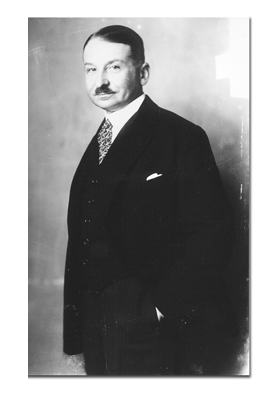
- 1. Property p. 18
2. Freedom p. 20
3. Peace
p. 23
4. Equality p. 27
5. The Inequality
of Wealth and Income p. 30
6. Private Property and Ethics p. 33
7. State
and Government p. 34
8. Democracy p. 39
9. Critique
of the Doctrine of Force p. 42
10. The Argument of Fascism p. 47
11. The
Limits of Governmental Activity p. 52
12. Tolerance p. 55
13. The
State and Antisocial Conduct p. 57
2 LIBERAL ECONOMIC POLICY
- 1. The Organization of the Economy p. 60
2. Private
Property and Its Critics p. 63
3. Private Property and the Government p. 67
4. The
Impracticability of Socialism p. 70
5. Interventionism p. 75
6. Capitalism:
The Only Possible System of Social Organization p. 85
7. Cartels, Monopolies, and Liberalism p. 90
8.
Bureaucratization p. 95
3 LIBERAL FOREIGN POLICY
- 1. The Boundaries of the State p. 105
2. The
Right of Self-Determination p. 108
3. The Political Foundations of Peace p. 110
4.
Nationalism p. 118
5. Imperialism p 121
6.
Colonial Policy p. 124
7. Free Trade p. 130
8.
Freedom of Movement p. 136
9. The United States of Europe
p. 142
10. The League of Nations p. 147
11. Russia
p. 151
4 LIBERALISM AND THE POLITICAL PARTIES
- 1. The "Doctrinairism" of the Liberals p. 155
2. Political
Parties p. 158
3. The Crisis of Parliamentarism and the Idea of a Diet Representing Special Groups
p. 170
4. Liberalism and the Parties of Special Interests p. 175
5. Party
Propaganda and Party Organization p. 179
6. Liberalism as the "Party of Capital" p.
183
5 THE FUTURE OF LIBERALISM p. 188
APPENDIX
- 1. On the Literature of Liberalism p. 194
2. On
the Term "Liberalism" p. 198
Glossary by Percy Greaves
If it sounds like "classical liberalism" is just "right-wing libertarianism," there may be more than meets the eye. The common "left-right"
"blue-red" dichotomy may not be helpful in making real social progress.
According to author Barry Clark, "Leftists... claim that human development flourishes when individuals engage in cooperative, mutually respectful relations that can
thrive only when excessive differences in status, power, and wealth are eliminated."
Clark, B., Political economy: A Comparative Approach, Westport, CT:
Praeger Press (1998).
Left-wing politics - Wikipedia, the free encyclopedia
This campaign supports the flourishing of human development and "cooperative, mutually respectful relations." There are five words that need explication:
- excessive
- status
- power
- wealth
- eliminated
"Excessive"
How much is "excessive?" "Who decides?"
"Status"
Michael Jordan held the status of a great basketball player. I don't begrudge him that status. He earned it and I can't beat him at it. The
difference in status between us is immense. Is the difference "excessive?" Why should it be "eliminated?"
Anne Elizabeth Alice Louis is known as
"Anne, Princess Royal, KG KT GCVO GCStJ QSO GCL." The abbreviations signify, "Royal Knight Companion of the Order of the Garter," "Knight Companion
of the Order of the Thistle," "Dame Grand Cross of the Royal Victorian Order," "Bailiff Grand Cross of the Order of St John," "Companion of the
Queen's Service Order," and "Grand Companion of the Order of Logohu." I'd be willing to bet that Anne did not have to work as hard to gain the status of
"Princess Royal" as Michael Jordan had to work to gain the status of "basketball legend."
"Power"
Wikipedia lists the following forms of "power" in the social/political realm:
Good Power
|
Bad Power
|
| Matthew
28:18
And Jesus came and spake unto them, saying, All power is given unto me in heaven and in earth.
|
Luke
4:6
And the devil said unto him, All this power will I give thee, and the glory of them: for that is delivered unto me; and to whomsoever I will I give it.
|
| Luke
4:32
And they were astonished at his doctrine: for his word was with power.
|
Luke
20:20
And they watched him, and sent forth spies, which should feign themselves just men, that they might take hold of his words, that so they might deliver him unto the power
and authority of the governor.
|
| Luke
24:49
And, behold, I send the promise of my Father upon you: but tarry ye in the city of Jerusalem, until ye be endued with power from on high.
|
John
19:10
Then saith Pilate unto him, Speakest thou not unto me? knowest thou not that I have power to crucify thee, and have power to release thee?
Jesus
answered, Thou couldest have no power
at all against me, except it were given thee from above: therefore he that delivered me unto thee hath the greater sin.
|
| John
1:12
But as many as received him, to them gave he power to become the sons of God, even to them that believe on his name:
|
Romans
13:1
Let every soul be subject unto the higher powers. For there is no power but of God: the powers that be are ordained of God.
2 Whosoever
therefore resisteth the power, resisteth the ordinance of God: and they that resist shall receive to themselves damnation.
3 For
rulers are not a terror to good works, but to the evil. Wilt thou then not be afraid of the power? do that which is good, and thou shalt have praise of the
same:
|
When "power" means "initiation of force or threats of violence" -- "legally" or without negative social consequences --
it is contrary to the commands of Christ, even though said to be "legal."
I don't feel like a "Leftist" for saying that.
"Wealth"
Income inequality is not a problem. Even if "excessive."
"Eliminated"
By whom? Using what force? Using unChristlike "power?"
Here are some other pages on this website which may open new doors:
next: Campaign Finance, Corruption and the Oath of Office
|

